A Complete Beginner Guide
Training your dog to follow basic commands is one of the most important parts of responsible pet ownership. Commands like sit and down help create better communication between you and your dog while improving safety and behavior in everyday situations.
Many dog owners start teaching these commands early, but sometimes dogs struggle with them. Some dogs may refuse to sit, while others may roll onto their backs when they see food in your hand. Fortunately, with the right training techniques and patience, most dogs can successfully learn these essential behaviors.
In this guide, you will learn how to teach your dog the sit and down commands, along with other important training behaviors such as stationing, watch, and recall.
Why Sit and Down Are Important Commands
The sit command is often the first behavior dogs learn. It teaches patience and helps control your dog in situations such as greeting visitors, feeding time, or preparing for walks.
The down command encourages calm behavior and relaxation. It is especially helpful when you want your dog to remain still for longer periods.
Teaching these two commands builds a strong foundation for more advanced training.
Step-by-Step Guide to Teaching the Sit Command
Most trainers start teaching sit using a method called luring, which involves guiding the dog into position with food.
Basic Sit Training Method
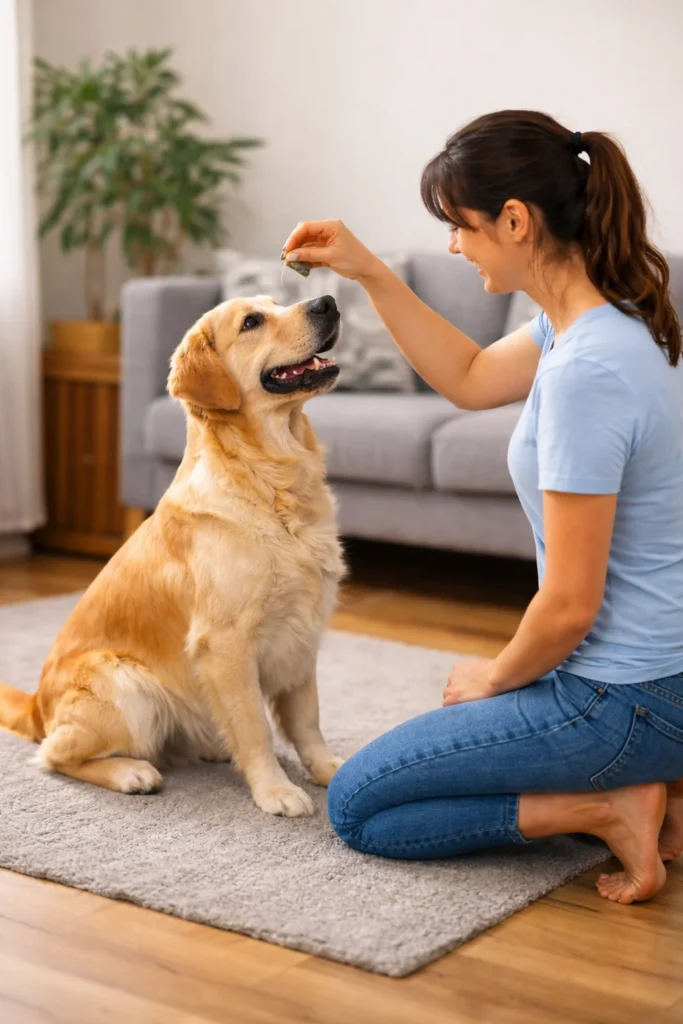
- Hold a treat close to your dog’s nose.
- Slowly move the treat upward and slightly backward.
- As your dog follows the treat with his head, his body will naturally lower into a sitting position.
- The moment your dog sits, reward him with the treat and praise.
Repeat this several times so your dog begins to associate the sitting motion with rewards.
When Dogs Struggle With Sit: Plan B Training
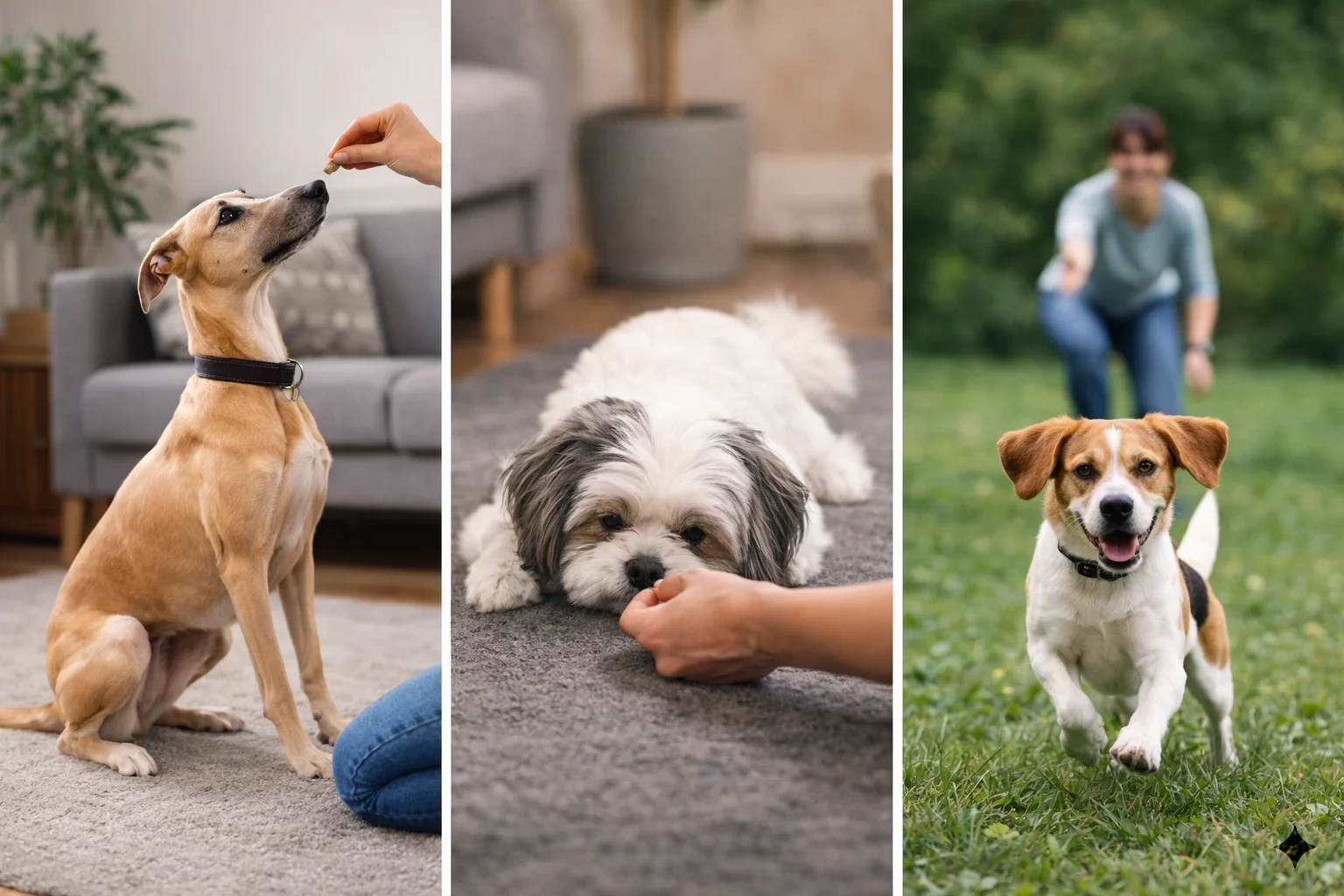
Some dogs do not easily respond to the basic sit lure. This can happen with:
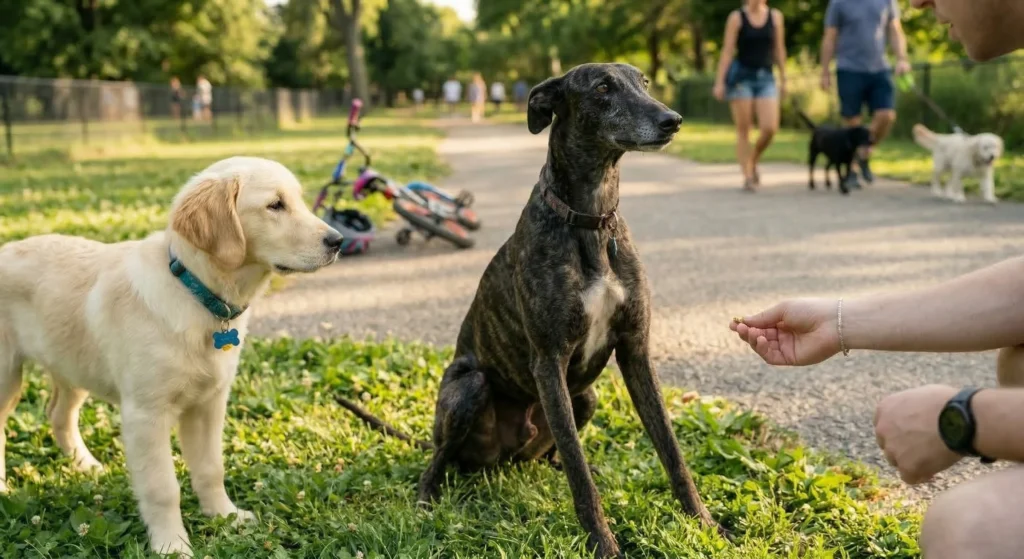
- Greyhound-type dogs with slim builds
- Small dogs that prefer lying down instead of sitting
- Dogs that become excited when they see food
In these situations, trainers use Plan B, which focuses on gradually shaping the behavior instead of forcing the dog into position.
Rather than trying to lure the dog directly into a sit, reward small steps toward the behavior. For example:
- Reward when the dog slightly bends his back legs
- Reward when the dog lowers his hips
- Eventually reward the full sitting position
This shaping method allows the dog to learn the movement more comfortably.
Teaching the Down Command
Once your dog understands the sit command, you can begin teaching down.
Down From Sit Method
- Start with your dog sitting.
- Hold a treat in front of his nose.
- Slowly move the treat toward the ground.
- When the dog follows the treat and lies down, reward immediately.
Some dogs quickly learn this behavior, while others need several practice sessions.
Plan C for Sit and Down Training
Sometimes dogs get stuck between training steps. They may begin the motion but stop halfway.
In these cases, trainers use Plan C, which involves breaking the behavior into even smaller steps.
Examples include:
- Rewarding the dog for simply bending his legs
- Rewarding partial movements toward the floor
- Gradually increasing expectations
This method prevents frustration for both the dog and the trainer.
Understanding Different Sit Movements
Interestingly, not all sits are the same.
Dogs use different muscles depending on their starting position.
Sit From Stand
When a dog sits from a standing position, he rocks his body backward to lower his hips.
Sit From Down
When a dog sits from a lying position, he pushes himself upward using his front legs.
Humans often think of “sit” as a single action, but dogs learn the specific muscle movements involved in each version.
With enough repetition, dogs can eventually understand that both movements respond to the same command.
Teaching Stationing
Another helpful training behavior is called stationing.
Stationing means teaching your dog to remain still in one place while something else happens.
This skill is extremely useful during:
- Grooming
- Veterinary examinations
- Nail trimming
- Teeth brushing
For example, a dog trained in stationing can calmly stay in place while a veterinarian checks his ears or mouth.
Targeting vs Stationing
Stationing is closely related to a behavior called targeting.
- Targeting means touching a specific object or location.
- Stationing adds duration, meaning the dog stays in that position for longer periods.
If a dog is uncomfortable with handling around the face, trainers sometimes teach a chin rest, where the dog gently rests his chin on a hand or surface.
This method helps dogs feel safer during handling.
Teaching the Watch Command
The watch command teaches your dog to look directly at you and maintain eye contact.
This is extremely useful during walks, especially if your dog becomes distracted by other animals or people.
Basic Watch Training
- Hold a treat in your hand.
- Wait until your dog looks away from the treat and toward your face.
- Immediately reward the dog.
Over time, the dog learns that looking at you brings rewards.
Using the Premack Principle in Dog Training
The watch command can be trained using something called Premack’s Principle.
This principle states that a high-probability behavior can reinforce a low-probability behavior.
For example:
- Dogs naturally want to eat food (high probability).
- Looking away from food is difficult (low probability).
By rewarding eye contact with food, you encourage the dog to repeat the behavior.
This training concept is often described using a simple rule:
“First do the less exciting task, then get the reward.”
Teaching Recall: Coming When Called
One of the most important commands any dog can learn is recall, which means coming when called.
A strong recall can protect your dog from dangerous situations, especially outdoors.
However, recall is considered an expensive behavior for dogs.
This means the dog is giving up something interesting—such as chasing, exploring, or playing—to come back to you.
Because of this, recall training must be highly rewarding.
Starting Recall With Pavlovian Conditioning
Unlike other behaviors, recall training often begins with classical conditioning, also known as Pavlovian conditioning.
This method teaches dogs that a specific sound predicts something amazing.
Example Training Exercise
- Say your recall cue (such as a word or whistle).
- Immediately give your dog a large reward or treat party.
- Repeat this at random times throughout the day.
At this stage, no behavior is required.
The dog simply learns that the cue predicts something wonderful.
Choosing the Right Recall Cue
Many trainers recommend choosing a unique recall word or sound.
This could be:
- A whistle
- A unique word
- A cheerful phrase
Using a new cue prevents confusion if the dog has previously ignored commands like “come.”
Protecting Your Recall Training
When building recall, it is important not to use the command too early.
Instead, focus on building strong positive associations first.
Once the recall cue is fully established, you can begin practicing the behavior in controlled environments.
Key Dog Training Concepts Explained
Understanding a few basic training concepts can make dog training much easier.
Inter-Trial Latency (ITL)
Inter-trial latency refers to the time between training repetitions.
Effective trainers keep this time short so the dog remains focused and engaged.
Luring
A lure is typically food used to guide a dog into position.
Dogs naturally follow food with their noses, making this technique very effective for teaching movements.
Pavlovian Conditioning
This type of learning occurs when animals associate one event with another.
For example, if a leash always predicts a walk, the dog becomes excited when the leash appears.
Premack Principle
This principle uses a preferred activity to reinforce a less desirable one.
For example:
If your dog sits calmly, he may then be rewarded with playtime.
Final Thoughts
Teaching your dog commands like sit, down, watch, stationing, and recall builds the foundation for good behavior and communication.
Every dog learns at a different pace, so patience and consistency are essential. By using positive reinforcement, gradual shaping, and clear cues, you can help your dog become a confident and well-trained companion.
Regular short training sessions combined with rewards and encouragement will produce the best results.
With time and practice, these simple behaviors can transform everyday life with your dog into a more enjoyable and cooperative experience.